Most people comparing Wobo and Click Hired assume the question is simply "which one is faster?" That's the wrong frame. Both tools use AI to speed up job applications, but they make a fundamentally different bet about where the human should stay in the loop — and that decision has downstream consequences for application quality, billing risk, and what happens to your search at scale.
Here's a straight comparison of what each tool actually is, what it costs, and when one makes more sense than the other.
Two different bets on where the human should stay in the loop — and why the choice matters more than the price difference.
What Each Tool Actually Does
The clearest way to separate these two products is by where the automation stops.
Wobo is built around submission. Its flagship mode on the Unlimited and Autopilot plans applies to jobs on your behalf — filling out forms, generating cover letters, and in the case of its Autopilot tier, selecting and applying to roles in the background without any per-job confirmation from you. On the Unlimited plan ($34.99/month), Wobo's Swipe-to-Apply UI gives you a card-style interface where you approve each job before it goes out. On Autopilot ($44.99/month), both the selection and submission happen automatically — you're not involved in either step.
Click Hired stops short of submission by design. You bring a job link or browse the platform's matched listings, and Click Hired generates a tailored resume, cover letter, and screener question answers in about 30 seconds. Then you review everything and submit it yourself. Nothing goes to an employer without your sign-off. The platform's FAQ is explicit about this: it does not apply automatically.
Those aren't minor UX differences. They represent opposite philosophies about what "help" means in a job search.
How the Pricing Actually Compares
Wobo's current pricing (verified June 2026) runs across three tiers: a Free plan with 5 applications per day, Unlimited at $34.99/month, and Autopilot at $44.99/month. The 5-day free trial available on the Autopilot plan is worth reading the fine print on — Wobo's published terms state that if you don't cancel before submitting your 11th application, the subscription auto-renews, and that threshold can be crossed within hours on a plan designed to apply automatically.
Click Hired's pricing starts at $6.99/month for 5 complete tailored applications and goes to $24.99/month for 35. A 7-day free trial is included with card required.
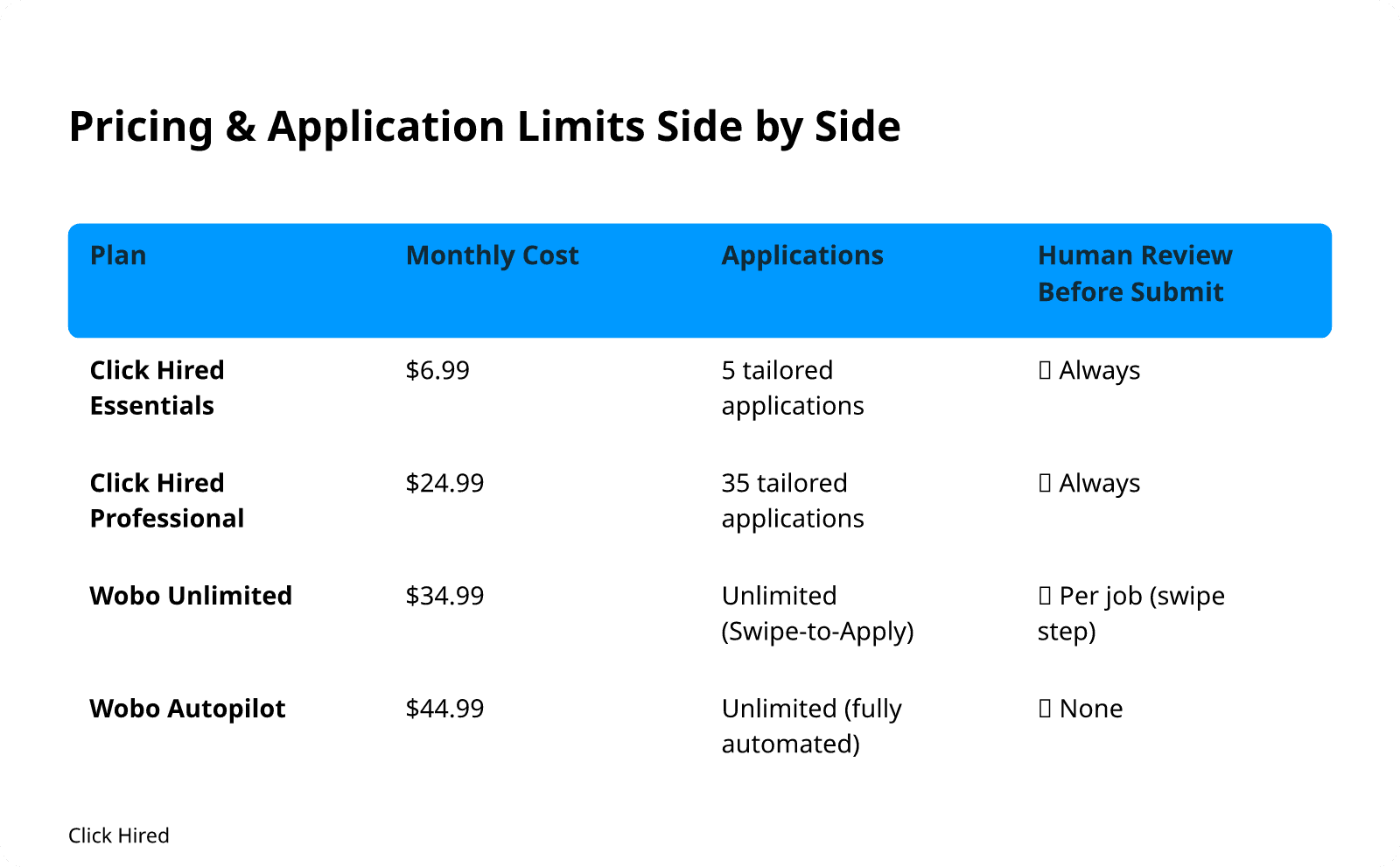
Wobo's per-application cost approaches zero at volume; Click Hired's cost per application is fixed but includes a tailored resume, cover letter, and screener answers every time. Verify Wobo's pricing at checkout before committing — tiers were restructured in 2025–2026.
The cost-per-application math looks very different depending on where you land. At Click Hired's Professional plan, 35 tailored applications per month works out to roughly $0.71 each — but each one includes a tailored resume, tailored cover letter, screener answers, and a keyword-match score before you apply. At Wobo's Unlimited plan, unlimited applications approaches $0 per application at volume, but with an important caveat: AI-tailored resumes are locked to the Autopilot tier. On the $34.99 Unlimited plan, the same resume goes to every role unless you pay up to Autopilot.
That matters because the application volume data doesn't favor generic approaches. In Huntr's Q2 2026 dataset covering 90,924 logged applications, interview rate per application fell from 8.12% for people who logged 11–20 applications to 2.86% for those logging over 100. That's observational data — it can't tell you the cause — but the direction is consistent: more applications don't buy proportionally more interviews, especially if the underlying quality doesn't scale with the volume.
The Quality-at-Volume Problem
This is where the human-review trade-off becomes concrete.
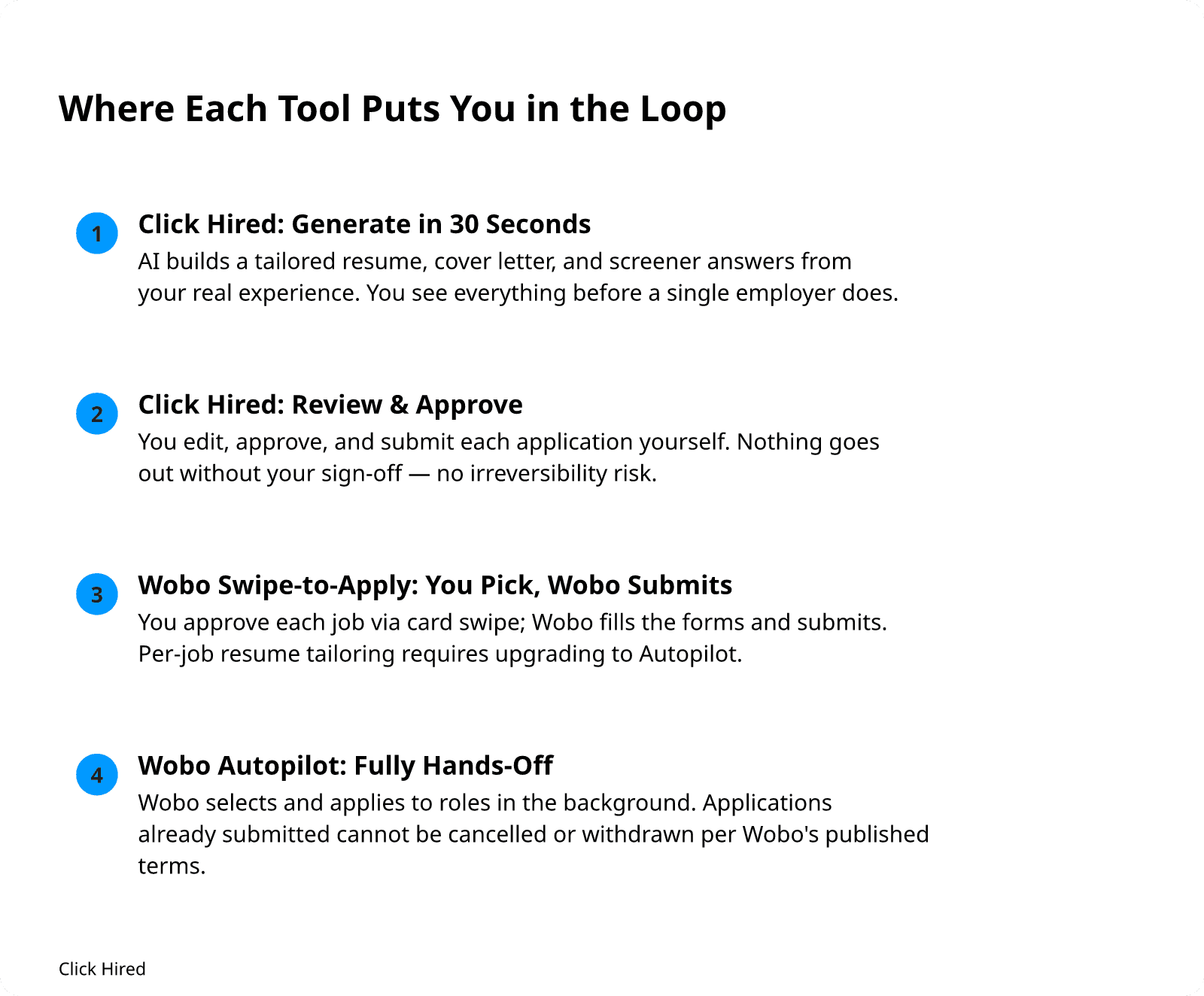
The automation trade-off isn't just about speed — it affects what gets reviewed, what gets tailored, and what happens if you change your mind after an application goes out.
Wobo's Autopilot plan does tailor resumes per application, which addresses one concern. But a consistent complaint across independent 2026 Wobo reviews is limited visibility into the specific details of applications before they go out, and the irreversibility risk is real: per Wobo's published terms, canceling or pausing a subscription does not cancel applications already submitted. Once an application goes out on your behalf, it stays with that employer regardless of what you do with your account afterward.
Click Hired takes the opposite position: every application is reviewed and approved by you before it moves. The platform claims a 98% ATS pass rate on generated resumes (owner-stated figure; no independent audit was cited in available sources). The tailored output — resume, cover letter, and screener answers — is built from your actual experience rather than invented detail, and the user edits and approves before submitting.
For niche roles, senior positions, or any application where the stakes are high enough that you'd want to re-read what's going out, the review step isn't overhead — it's the point.
Feature Gaps Worth Knowing About
Beyond the core automation question, a few practical differences affect day-to-day use:
Screener/application question answers: Click Hired generates these per application as part of the standard output. Wobo's Persona model handles application form fields, but the methodology for per-question personalization is not publicly documented.
Per-job resume tailoring: Available on every Click Hired application regardless of tier. On Wobo, resume tailoring is an Autopilot-only feature — not included on the $34.99 Unlimited plan.
Application tracking: Both platforms include a dashboard for tracking application status.
Job sources: Wobo aggregates from 50+ sources and claims pre-vetted listings with no ghost jobs — a claim that couldn't be independently confirmed in available research. Click Hired scans 250,000+ jobs matched to your profile and lets you paste any external link from anywhere.
Niche and senior role coverage: Independent reviewers note that Wobo's source mix favors mainstream job boards, so roles in academia, design-portfolio-heavy fields, or very senior executive tiers may be under-represented.
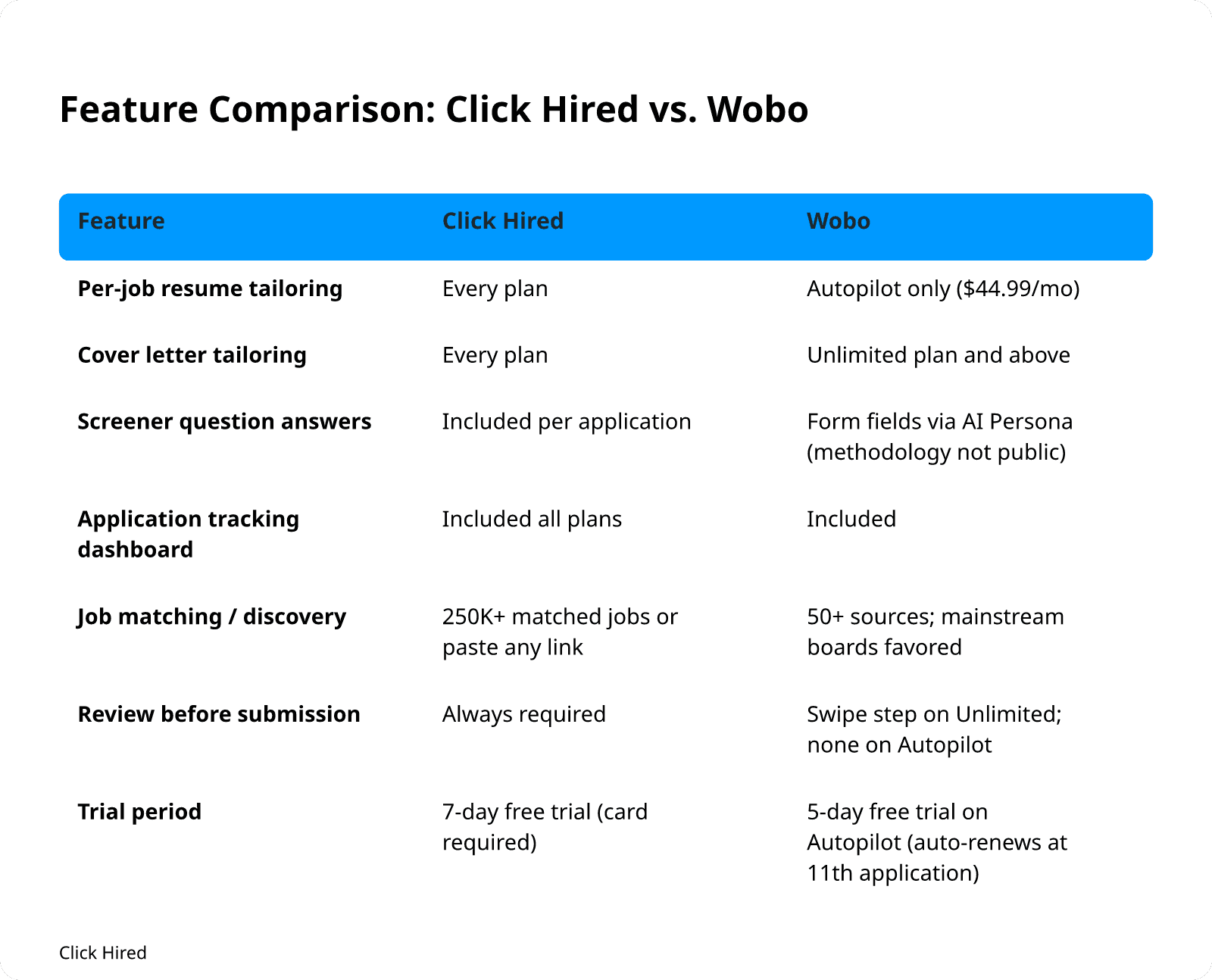
Key feature differences beyond pricing — particularly relevant for candidates in senior roles, niche fields, or those applying to jobs with screener questions.
Which One Fits Which Search
The honest answer is that these tools aren't direct substitutes — they're optimized for different job-search strategies.
Wobo Unlimited or Autopilot makes sense if: You're running a high-volume search, you're comfortable with applications going out on your behalf, and you're applying to roles where the fit is broad enough that you don't need to re-read every document before it goes. The Swipe-to-Apply mode on the Unlimited plan gives you a per-job confirmation step, which is a reasonable middle ground. Just read the cancellation terms before the trial ends.
Click Hired makes sense if: You want every application to be tailored — resume, cover letter, and screener answers — and you want to review it before it goes anywhere. It's the better fit for candidates with real work history who need each application to reflect specific experience accurately, for anyone applying to roles where the details matter (senior positions, career changes, roles with specific screener questions), and for anyone who had a bad experience with automation sending applications they wouldn't have approved.
The volume argument for Autopilot tools only holds if quality stays consistent at scale. If it doesn't — if the applications going out don't accurately reflect what you bring to the role — volume makes the problem worse, not better.
Ready to see the difference a reviewed, tailored application makes? Click Hired's 7-day free trial lets you build your first complete application — resume, cover letter, and screener answers — and decide if the output is worth submitting. Start free trial at clickhired.ai.